If you’re promoting something new — a software feature, a subscription tier, a donor program, or a training experience — you’ve likely felt that uncomfortable tension:
Adoption is still low… so how do I talk about it without making it sound small?
This is one of the most common dilemmas leaders, fundraisers, and sales professionals face. You’re excited. You know the value. You believe in the impact. But when early numbers feel modest, there’s a fear that sharing them will diminish credibility.
No one wants to promote something that looks “untested.” No one wants to accidentally signal that low adoption equals low value.
But here’s the truth:
Every major movement, every breakthrough product, every seven-figure campaign, and every high-performing initiative starts small.
And fortunately, there’s a science-backed way to talk about early traction without hurting momentum — one that fits perfectly with the ethical influence principles I teach in my work.
It’s called future social proof.
And it comes straight from the research of Dr. Robert Cialdini.
When Numbers Are Small, the Story You Tell Matters Even More
Traditional social proof leans on “everyone is doing it” messaging. That works beautifully — once everyone is doing it.
But what about the beginning?
What about when 30 people have joined your new program… or eight donors have stepped up for a new fund… or your first handful of clients have upgraded to a premium tier?
Sharing small numbers can backfire. It makes your initiative look like a risk instead of an opportunity.
Yet hiding your numbers doesn’t build trust either — especially in a world where people expect transparency.
So what do you do?
You shift the focus from current adoption to credible momentum.
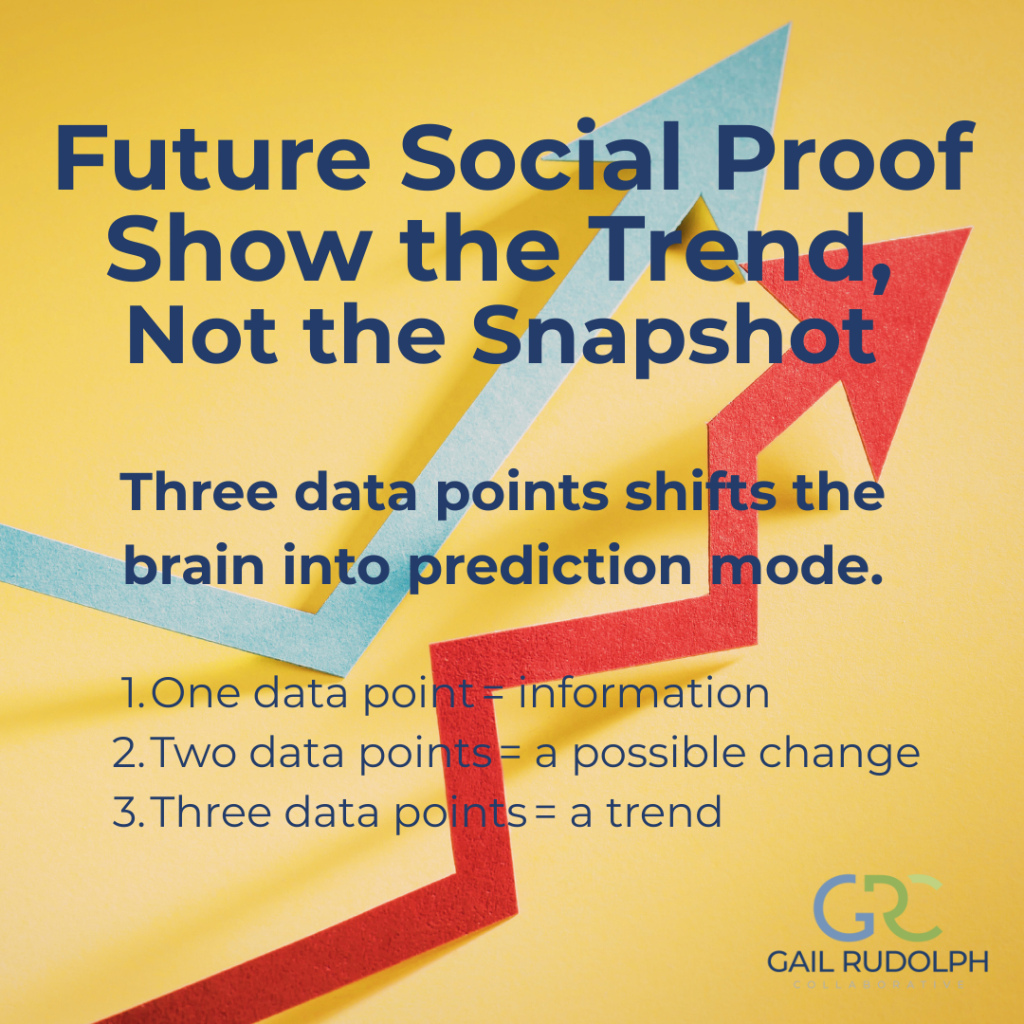
Future Social Proof: Show the Trend, Not the Snapshot
Instead of saying:
“Thirty people have joined our new program.”
You can say:
“Thirty people have already joined — and here’s the exciting part:
Four weeks ago, we launched with five.
Two weeks later, we were at 18.
Today we’re at 30 and growing every week.”
People don’t respond to isolated data.
They respond to direction.
Cialdini’s research shows that when you give people three data points, the brain instantly shifts into prediction mode.
Here’s the heuristic:
- One data point = information
- Two data points = a possible change
- Three data points = a trend
And when people see a trend, they assume it will continue.
This is human nature — we’re wired to anticipate what comes next. And when something appears to be rising, people want to be part of it before it peaks. That means more sign-ups, more donors, more participation, more upgrades, and more buy-in.
Why This Works in Sales, Fundraising, and Leadership
In Sales
Your clients don’t want to be the only ones making a purchase decision. But they love being early adopters of something that’s clearly picking up speed.
Future social proof positions your offer as:
- validated,
- gaining momentum,
- and smart to join now rather than later.
In Fundraising
Donors especially want to contribute to something that feels alive. Not “done,” not “desperate,” but moving.
Sharing momentum in a campaign activates:
- Social Proof (others are giving),
- Consistency (they want to be part of the group moving forward), and
- Scarcity (the window to be an early supporter won’t last).
Instead of focusing on “we’ve raised $X so far,” you highlight how the giving pattern is building.
In Leadership
Teams commit to what they believe is going somewhere.
Momentum creates morale — and morale creates movement.
When leaders showcase progress over time rather than static numbers, they help people see:
- their effort is working,
- their contribution matters,
- and they’re part of something that’s accelerating.
People don’t rally around a moment.
They rally around a movement.
A Small Shift: Sell the Direction, Not the Data
When adoption is low, you don’t have a numbers problem — you have a framing opportunity.
Remember the principle:
Don’t sell where you are.
Sell where you’re heading.
Your job isn’t to make small numbers sound big.
Your job is to turn early traction into credible momentum using three simple data points that showcase a rising trend.
Because when people see a trend, they don’t want to be on the sidelines.
They want to be part of the future majority.
And that’s the power of ethical influence at work — helping people say “yes” not out of pressure, but out of clarity.
If this message struck a chord, don’t stop here. The GRC Community is where leaders like you gain deeper insights, proven tools, and the encouragement to turn ideas into action. Join the Community today!
