Why No Sales Strategy, Fundraising Campaign, or Leadership Framework Will Work If Your Nervous System Is Working Against You
One of the biggest misconceptions in sales, fundraising, and leadership is this:
If something isn’t working, the solution must be a better strategy.
A new script.
A new fundraising campaign.
A better CRM.
A sharper pitch deck.
Another sales framework.
But after decades in executive leadership, fundraising, and training people to influence ethically, I can tell you something that surprises many professionals:
No strategy will solve a nervous system problem.
You can have the best sales process in the world.
You can have a brilliant fundraising case for support.
You can have the right leadership message.
And none of it will matter if, in the moment that influence is required, your nervous system collapses.
Because influence is not just intellectual.
It’s physiological.
The Real Gap Isn’t Strategy. It’s the Inner Game.
Over the years, I’ve coached leaders, fundraisers, and sales professionals across industries.
Many of them are incredibly intelligent.
Many have excellent strategies.
Yet some people break through and others plateau.
The difference is rarely resources.
The difference is rarely knowledge.
The difference is what I call the inner game of influence.
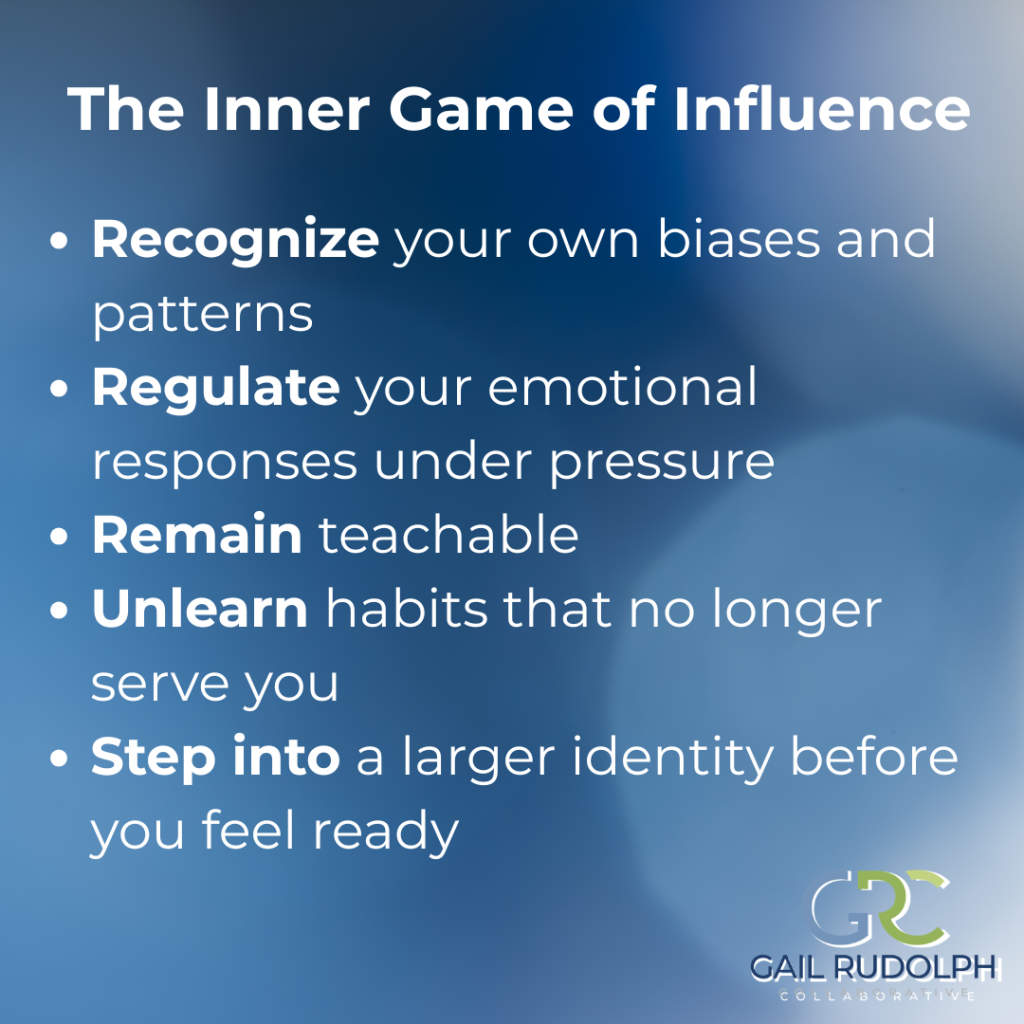
The inner game is your ability to:
- Recognize your own biases and patterns
- Regulate your emotional responses under pressure
- Remain teachable
- Unlearn habits that no longer serve you
- Step into a larger identity before you feel ready
This matters because in leadership, sales, and fundraising, you are the instrument of influence.
Your posture communicates before your words do.
Your tone signals certainty before your logic does.
Your presence determines whether people trust you enough to say yes.
You can hide behind a polished LinkedIn post or a carefully edited video.
But eventually you end up in a room with a donor, a client, or a board member.
And that’s when the editing stops.
What remains is the inner game.
The Inversion Principle: Start With Failure
One of the most powerful mental models I use in leadership and fundraising strategy comes from Charlie Munger, Warren Buffett’s longtime partner.
Before becoming an investor, Munger worked in air traffic control.
His job was to keep pilots alive.
His thinking was simple.
Instead of asking:
“How do I succeed?”
He asked:
“What would guarantee these planes crash?”
Then he made sure those things never happened.
This is known as inversion.
To succeed, study what guarantees failure and do the opposite.
What Failure Looks Like in Sales and Fundraising
Early in a career, the inversion questions are obvious.
What would guarantee failure?
- Never making the ask.
- Avoiding difficult conversations.
- Spending more time planning than doing.
- Waiting until everything feels perfect.
The solution is straightforward.
Do the opposite.
Make the call.
Have the conversation.
Put the opportunity in front of people.
But something interesting happens once you become successful.
The inversion questions change.
They become quieter.
And far more dangerous.
The Hidden Trap of Success
In leadership, sales, and fundraising, it is entirely possible to build a life that looks successful on the outside…
…and feels like a prison on the inside.
You built it.
Brick by brick.
Campaign by campaign.
Client by client.
But now momentum is running the show.
You say yes to everything.
You move so fast you can’t slow down.
You optimize for efficiency instead of evolution.
From the outside, it looks like the dream.
From the inside, something feels off.
And this is where the inner game matters most.
Because if you apply Munger’s inversion again, the answer becomes clear.
What would guarantee long-term burnout?
Keep doing exactly what you’ve been doing.
The Identity Shift That Changes Everything
One of the most important lessons I’ve learned from elite performance coaches and neuroscience research is this:
Most people believe identity must change before behavior.
But in reality, the order is reversed.
Identity follows evidence.
In other words:
You don’t believe first.
You act first.
The belief catches up.
This is true in athletics.
It’s true in leadership.
And it’s absolutely true in sales and fundraising.
You don’t wake up believing you’re capable of securing transformational gifts.
You become that person by stepping into the conversations, doing the work, and building the evidence.
The same is true in sales.
The first sale always happens internally.
Before a client buys your product…
Before a donor invests in your mission…
You must believe – in your body, not just intellectually – that what you are offering matters.
The Hidden Signals of the Inner Game
When I run leadership workshops or fundraising training sessions, I see the inner game show up physically.
A participant presents a challenge.
Others start offering insights.
And suddenly the body language shifts.
Arms cross.
People interrupt before a question finishes.
They start explaining instead of listening.
Defending instead of receiving.
It’s subtle.
But it’s revealing.
The most successful leaders and fundraisers I know share one trait above all others:
They are incredibly teachable.
Not defensive.
Not performative.
Teachable.
Because they understand something critical:
Growth requires letting new ideas in.
Power Up. Power Down.
In my work I often teach the concept of Power Up and Power Down.
Not in the way most people assume.
Power Up is not aggression.
Power Up is refusing to shrink.
It’s holding steady when the room gets uncomfortable.
Power Down is not weakness.
Power Down is control.
It’s slowing down when everyone else speeds up.
It’s allowing silence instead of filling every gap with words.
The inner game lives in that range.
Because influence doesn’t come from force.
It comes from presence.
The Shift From Hoarding to Compounding
Something else changes when the inner game matures.
Early in a career, opportunities feel scarce.
You guard them tightly.
You protect every room, every introduction, every spotlight.
But the most successful leaders I know think differently.
They compound opportunity.
One conversation becomes three partnerships.
One event becomes multiple collaborations.
One introduction becomes an ecosystem.
In fundraising, this looks like partnerships.
In sales, it looks like networks.
In leadership, it looks like shared success.
But this only happens when the inner game is strong enough to stop treating every opportunity like a zero-sum competition.
The Three Questions That Strengthen the Inner Game
If you want to strengthen your influence in sales, fundraising, or leadership, start with three questions.
1. What would guarantee failure?
Inversion reveals blind spots strategy never will.
2. What identity must I step into next?
Not what you believe today.
What version of you the next level requires.
3. What patterns are blocking what I say I want?
The interruptions.
The defensiveness.
The hesitation to ask.
These are signals.
Not flaws.
Signals.
The Inner Game Never Ends
Influence is not just tactics.
It is evolution.
You must constantly:
Learn.
Unlearn.
Relearn.
Because the next level of impact will not come from better scripts or better tools alone.
It will come from becoming the kind of leader, fundraiser, or salesperson who can hold bigger conversations, bigger rooms, and bigger responsibility.
The inner game is where that transformation happens.
And the work is never finished.
But it is always worth it.
